
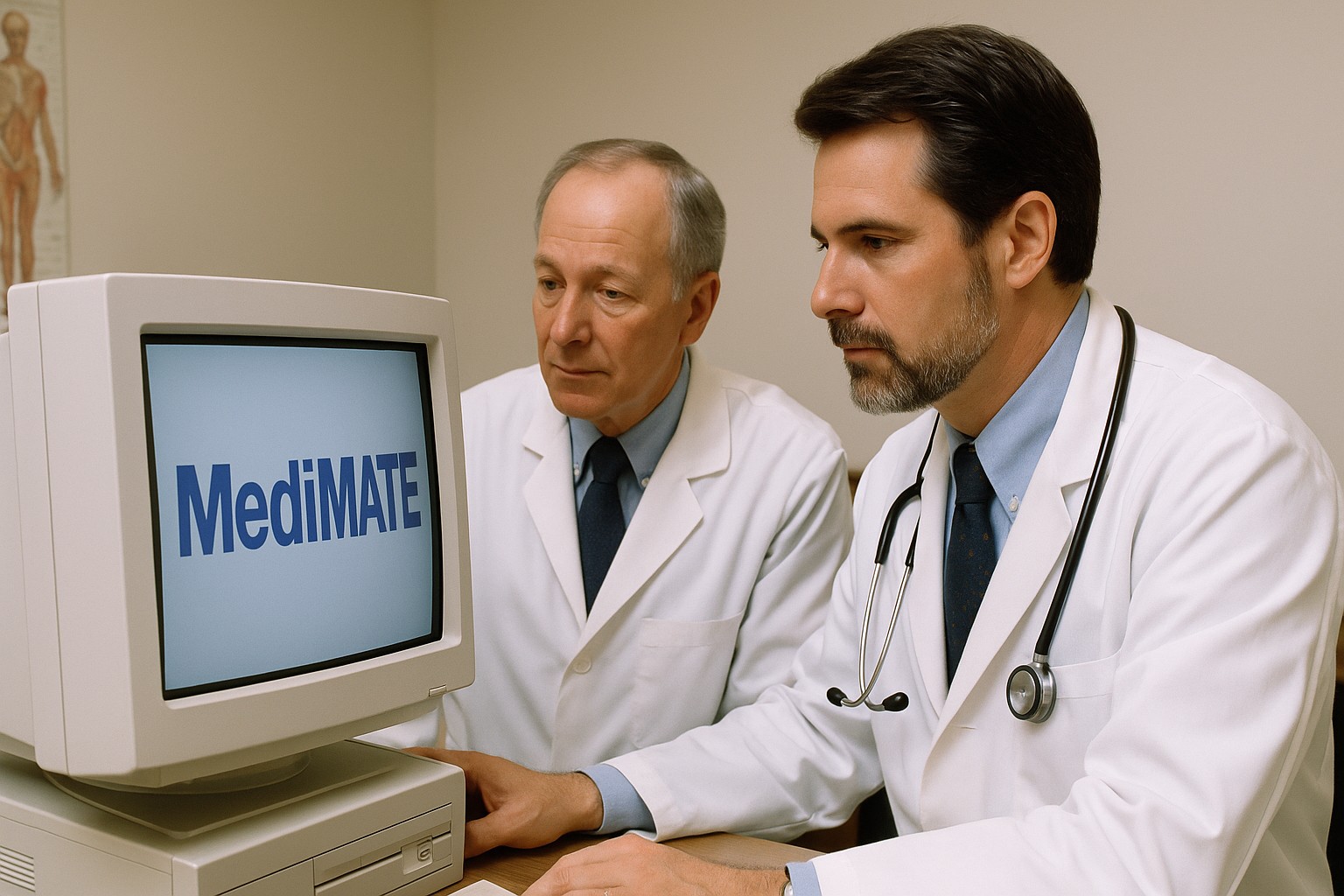
In 1995, at a time when most medical practices were still buried in paper records, a groundbreaking electronic medical records system called MediMATE was born. Developed specifically for a small medical practice led by Dr. Tuthill and Dr. Coletta in the Hillcrest building of Mayfield Heights, MediMATE was among the first systems of its kind. It was designed to digitize patient records, streamline appointment scheduling, and enhance the overall efficiency of the practice.
Dr. Tuthill and Dr. Coletta were early visionaries who recognized the potential of electronic records to improve patient care. By adopting MediMATE, they were able to move away from cumbersome paper files and embrace a more efficient, accurate, and accessible way of managing patient information. The system allowed them to quickly access patient histories, streamline workflows, and reduce the risk of errors, setting a new standard for medical practices.
MediMATE’s impact extended beyond the walls of their practice. As one of the first EMR systems of its kind, it demonstrated the transformative power of technology in healthcare. It showed other practitioners the benefits of moving to digital records, paving the way for broader adoption and innovation in electronic medical records. The vision and forward-thinking approach of Dr. Tuthill and Dr. Coletta, combined with the innovative design of MediMATE, left a lasting legacy that helped shape the future of healthcare technology.

In a world where technology is rapidly reshaping creative industries, artificial intelligence is proving to be one of the most transformative forces in photography. From automating post-production workflows to generating fully immersive environments, AI is not only accelerating the pace of visual storytelling but unlocking new realms of possibility. At the forefront of this revolution is AutoVision Studios, a company blending expert photography with AI-generated backgrounds to produce stunning automotive imagery.
Traditionally, automotive photography has required transporting vehicles to scenic locations, carefully choreographing lighting, and often waiting on ideal weather conditions. AutoVision Studios turns that model on its head. By capturing cars in controlled studio or event settings and using AI to create photorealistic backgrounds—from desert highways to urban skylines—AutoVision gives photographers and clients the freedom to imagine any setting, season, or atmosphere. The results are showroom-quality images created faster, more affordably, and with a level of creative control that was once impossible.
But AI’s impact doesn’t stop at scenery. Advanced algorithms assist in optimizing lighting, refining reflections, and even removing visual distractions—all with just a few clicks. This drastically reduces editing time and gives photographers more time to focus on artistry and composition. For AutoVision Studios, this means delivering high-volume, high-quality output for car collectors, dealerships, and automotive enthusiasts alike.
As AI continues to evolve, its role in photography will only deepen. AutoVision Studios is proving that technology and creativity are not at odds—they’re partners in producing imagery that’s not only visually compelling but emotionally resonant. In the age of AI, the lens hasn’t lost its soul—it’s just gained superpowers.

Artificial intelligence is revolutionizing healthcare, and I’ve had the privilege of witnessing this transformation firsthand. My journey with AI in healthcare began in the early 2000s at Guardian Technologies, where we developed a groundbreaking tool called Signature Mapping. This technology was designed to detect breast cancer in mammography images. At the time, the idea of using machine learning algorithms to analyze medical images was revolutionary. It allowed us to identify patterns that were difficult for the human eye to discern, ultimately improving early detection rates.
Building on that success, we expanded our technology to develop a pathology information system that could detect tuberculosis in slides for use in South Africa. This application of AI made a significant impact in regions where tuberculosis diagnosis was critical, helping healthcare professionals make faster and more accurate diagnoses.
Years later, I had the opportunity to work at the Cleveland Clinic on an innovative project involving IBM Watson. We integrated Watson with Epic’s electronic medical records to create a system that could ingest and analyze vast amounts of clinical data. The result was a powerful tool capable of generating diagnostic suggestions and dashboards for healthcare providers. This AI-driven approach improved decision-making and personalized patient care, demonstrating the immense potential of AI in clinical settings.
These experiences have shown me how AI can truly advance healthcare, making diagnostics more accurate, treatment more personalized, and workflows more efficient. As AI continues to evolve, its role in healthcare will only grow, offering new possibilities for improving patient outcomes and transforming the way we deliver care.

In the late 1990s, the landscape of radiology was on the brink of transformation. At the heart of this change was RIS Logic, a company that started with just three people and a bold vision: to design one of the first radiology information systems on the market.
RIS Logic’s system streamlined radiology workflows by digitizing processes that were traditionally paper-based. The system allowed radiologists to manage patient data, schedule appointments, and track imaging studies with unprecedented efficiency. As the team grew from three to twenty-five members, the system evolved, incorporating new features and capabilities that set a new standard for the industry.
The success of RIS Logic caught the attention of Merge Healthcare, which acquired the company and integrated its technology into a broader suite of healthcare IT solutions. Eventually, Merge Healthcare itself was acquired by IBM, further cementing the legacy of RIS Logic as a foundational innovation in radiology information systems.
This journey from a small startup to a key player in healthcare IT illustrates the transformative power of innovation and the importance